For the anniversary of my life

When I was in college, I read and wrote a lot of poetry. It was both luxurious and exhausting, like mapping a geography that constantly changed. That was when I first encountered the work of W.S. Merwin. I don’t remember in what year of college I met Merwin’s poem “For the Anniversary of My Death,” but it was love at first read. The first line of the poem is inscribed into my memory, where it hangs out in the same room with lots of other firsts (stitches, swimming ribbon, kiss, love, broken heart, broken bone, etc.)

For the Anniversary of My Death

By W. S. Merwin

Every year without knowing it I have passed the day
When the last fires will wave to me
And the silence will set out
Tireless traveler
Like the beam of a lightless star

Then I will no longer
Find myself in life as in a strange garment
Surprised at the earth
And the love of one woman
And the shamelessness of men
As today writing after three days of rain
Hearing the wren sing and the falling cease
And bowing not knowing to what

There’s something about year’s end for me that highlights the collision between the inexorable march of the calendar and the concentric, infinite whorls of life giving way to death giving way to life. Maybe by the end of every year I just notice this collision more, as though the previous 11 months have worn away the insulation on my nerve endings. Whatever the reason, by November and December, I’m moved to tears more, I feel like I hear and feel everything more acutely, I notice more stuff that’s in my peripheral vision, and words, phrases, and melodies tumble around in my head like too much laundry crammed into a dryer. When I slow myself down to sort all this out, I feel mostly bewildered, as though I’m sifting through a great pile of mismatched socks.

So I’ve been quiet here for the past couple of months.

And it’s not like I suddenly feel I have something really profound to share today. I just need to be reconnected with this discipline, and with the small and mighty community of people who come here to share, to seek, to find, to laugh, to cry, to wonder, to ask, “Where in the world are we (or is she) going?” That is, after all, why I come here, too.

A little more than six weeks ago, I was in a spectacular—and still unbelievable—car accident. While I was sitting alone in my car, stopped at a light, a man half my age drove into the back of my car while he was travelling at least 45 mph, according to the police. There was no squealing of tires to warn me—he never even hit the brakes. For me there was just deafening noise and intense impact, as if a bomb had gone off in the trunk. When the dust cleared, I peered out my windshield to see a car lying on its side in front of me. It was the car that had just hit me.

I couldn’t process any of this at the time, and I still can’t. All I could manage to say when I stumbled out of my car in a fog of shock was, “What the…What just happened? What??” Wave after wave of onlookers, police, and EMTs, approached me to ask if I was hurt. “I…I don’t know. Um, I think I’m okay. I…What just happened? What the??” As it turned out, the only significant damage was to the cars involved, and the other driver’s insurance rates. I was extremely lucky to sustain merely an addled brain, a badly bruised knee, and a little whiplash.

I frequently find myself reflecting on my luck, particularly at the end of the year. This year, my reflections on my luck were accompanied by the relentlessly looping soundtrack of the car wreck, with a steady drumbeat of newsflashes that made my heart hurt:

  • A couple of weeks ago, I heard that a dear friend—a college classmate and a woman I have admired and adored for more than 30 years—has some kind of cancer that her oncologist isn’t even sure how to treat. She also recently lost her dad to leukemia.
  • On Christmas morning, as PW and I were walking into church a couple of hours before the service started, we encountered a woman standing outside Emmanuel looking at the various signs on the doors. “I’m looking for an Episcopal church,” she said. “I just found out that my husband of 34 years has been having an affair for the past three years, and I need to find a place to sit in church with my fine young son.” Sure enough, they showed up for the service and the son sat with his arm around his mother the entire time.
  • This past Friday, a long-time friend of my parents and college classmate of my mom’s died after a long ordeal with cancer. Barbara Higdon was classy, brave, brilliant, and one of those trail-blazing women on whose shoulders generations of other women stand, many of us without knowing it.

The day after I heard about my friend’s diagnosis, I was walking  through Chinatown and was frozen in place by this graffito:

There are many more heart-hurty news bits in the mix, but those three, plus the graffito, best capture the variety. As I was sitting in church on New Year’s Day, in the stunningly beautiful Lindsey Chapel, the low winter sun came streaming in the windows in such a startling way that many of the people in the congregation turned around and looked up. The room and the congregants were bathed in a brilliant, other-worldly light.

Meanwhile, Bishop J. Clark Grew (ret.) was preaching about the currency of hope, and how this year’s familiar Christmas narrative reminded him that the divine rarely breaks through in our lives in ways we expect. As if on cue, the words “for the anniversary of my life” floated across my mind’s eye in an unbroken line.

After my initial reaction (“What the heck? THAT’S not how Merwin’s poem goes!”), I felt like a dog resisting the pull of the leash. I wanted to investigate these words “for the anniversary of my life,” to spend a long time sniffing them, tumbling them around in my brain.

I don’t know if “for the anniversary of my life” and the graffito’s message “She knows she’ll never die!” were the divine breaking into my consciousness, but I’m open to the possibility. Maybe the openness to the possibility is the whole point. This morning I felt driven to pull one of my favorite books off the shelf: William Stafford’s “You Must Revise Your Life.” This slim little paperback is a combination magnifying glass and life raft when I encounter life’s mysteries. I mostly don’t want a decoder ring for life’s mysteries; I just want new ways to look at them without drowning.

The book is only 118 pages long, and in my copy I have folded over dozens of pages, underlined many passages, and bracketed entire paragraphs, usually putting stars next to the brackets. At the bottom of page 81, I have a couple of sentences bracketed, with a star, and above it I wrote, “This is it!”

“[T]he product is expendable, but the process is precious…The process is the process of living centrally and paying attention to your own life. Surely that’s worth doing. If you don’t, who will?”

In the sense that we all have an expiration date, the noun-ness of our lives is expendable. It’s the living itself — our verb-ness — that’s precious and unbounded by time: the ways we choose to live, whom and what we choose to notice, to share, to explore, to accompany, to hear, to carry with us. Sometimes we write, and sometimes we are surface on which others write. Barbara Higdon’s physical matter is dead, but the essence of her life cannot be extinguished; I’m still discovering ways in which she is written into me.

Like many people out there writing our lives from one day to the next, with and without words, I find myself beginning this year in wonder and mourning. I don’t know the ratio of one to the other, because, honestly, I feel filled with immeasurable amounts of both. Which brings me to another little poem, this one by a 12-year-old girl from New Zealand.

May your year ahead be so bold and brilliant. May your wonders be deep and your mournings be shared.

Dark, Dark night.
The trees. The river.
One more day;
For so slow goes the day.
Before the end
    the world goes round
        once more.
The world begins the day.
The night has gone.
The day for the end of the world
    once more begins.
Once more begins the sun
Slow, so slow.
Go on, world, live.
Begin, sweet sun.
Begin, sweet world.
The people live and die.
People die alive
    alive
        alive

By Lynette Joass
Age 12
New Zealand

From “Miracles: Poems by children of the English-speaking world,” collected by Richard Lewis.

Here’s a song for this post: Sweet Honey in the Rock singing “Breaths.”

Adventures on the Island of Misfit Toys

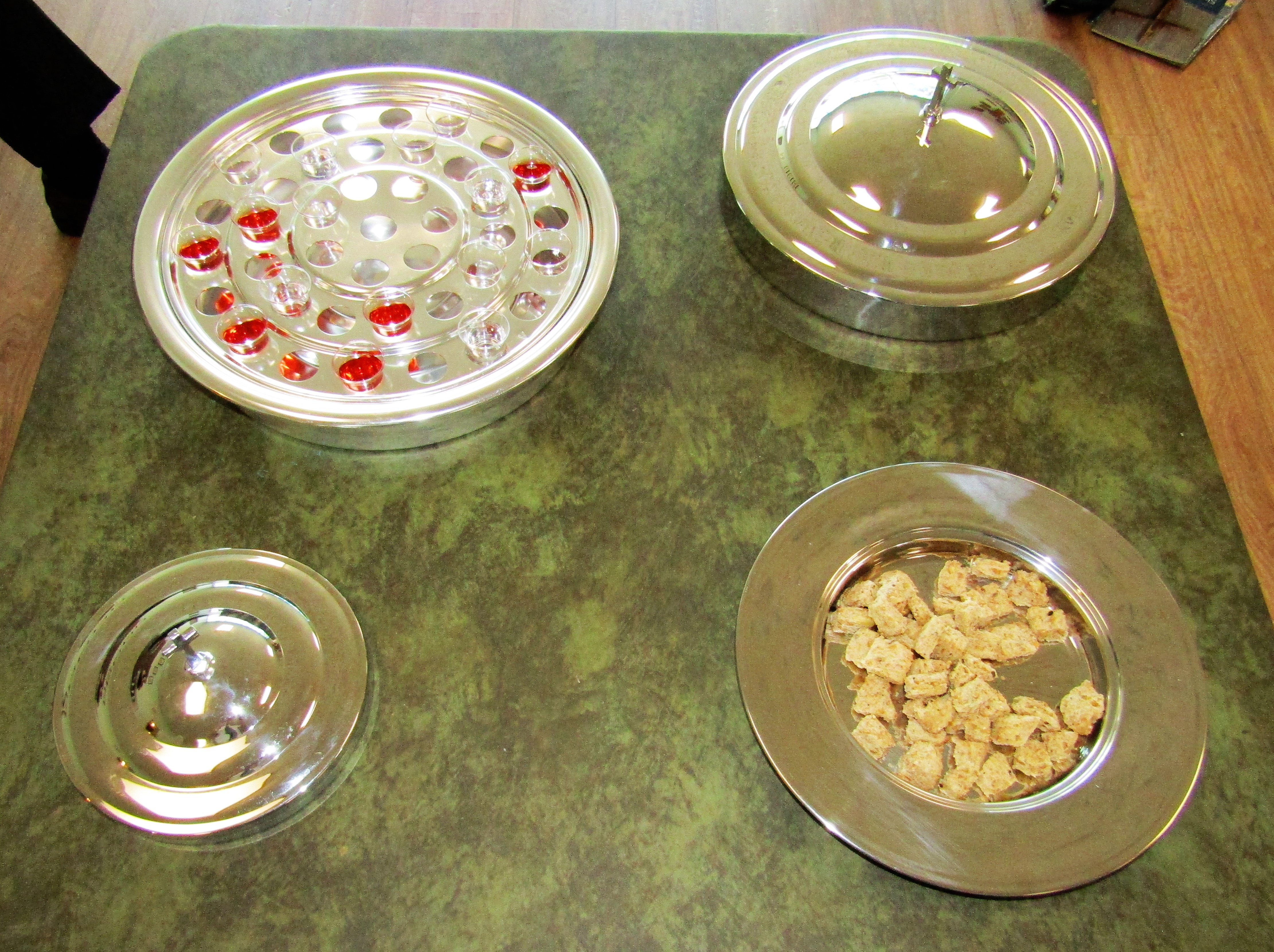
A couple of years ago, PW and a local rabbi presided over the wedding of a Romanian Orthodox Christian woman and a Russian Orthodox Jewish man. The wedding ceremony included a chuppa, a three crowns ceremony, and a eucharist, with challah made by the groom’s grandmother who lives in Israel and wine made by the bride’s father. I’m not sure what the grandmother thought happened at communion, because the challah loaf was approximately the size of a miniature pony.

At the wedding, some of the groom’s family surprised PW by lining up to receive communion, along with the bride’s family. In a scene that has long since taken on a life of its own, PW quickly changed the words of distribution to “Bread for the Journey” when she put bread in the hands of the Jewish family members (instead of “the body of Christ.”) She hadn’t had time to suggest alternate words to the chalice bearer, so she heard him repeat as he followed along behind her, “Blood for the Journey” (instead of “the blood of Christ.”)

Can I just say that, to me, never is Christian liturgy more like a Monty Python sketch than during communion? Of course I can, this is my website! The scene above is reason #814 why I wish Christianity would move past this yucky body and blood of Christ business. The first 813 reasons are that it’s just gross. This is the 21st century, folks. Must we STILL be littering our liturgies with the language of cannibalism and vampirism? But I digress.

This same couple brought their new baby to church last Sunday for the Jewish ceremony for naming a daughter, and a baptism. The church bulletin included the Jewish prayers in both English and Hebrew, along with the usual Episcopal baptism liturgy. In addition, we had the Boston Children’s Chorus as guest musicians, so we had a house full of company, so to speak. I’m sure most of us have never been involved in a service like this until Sunday.

Here's part of the worship bulletin for last Sunday

Male members of the groom’s/father’s family all wore matching bright pink kippot, perhaps in celebration of the new baby daughter? No idea what the color signified, if anything, but it was stunning. After brief remarks by PW and the rabbi, the families were invited up to the front for the Jewish ceremony, which included a Chair of Elijah and ceremonial sips of sweet wine from a kiddush cup. Immediately following, everyone moved down to the baptismal font for the baptism.

In PW’s comments prior to the two ceremonies, she noted that the baby girl (whose name combines the Greek word for “wisdom” with the Hebrew word for “life”) would have full dual citizenship as a Jew and a Christian. This will likely be a stumbling block for many on both sides of her citizenship aisle, since we humans are notoriously exclusively-minded. I can hear it now:

“What religion are you?”
“I’m Jewish and Christian.”
“What? You can’t be both?”
“Yes I can!”
“No you can’t!”
“I already am!”
“No you aren’t!”
“Oh yes I AM!”

This imagined conversation reminds me of the time I picked up GForce at preschool one day and overheard a boy asking where her dad was and why he didn’t ever pick her up.

“Who is your dad?”
“I don’t have a dad. I have three moms.”
“You can’t have three moms!”
“Well, I do!”
“But where’s your dad?”
“I don’t have a dad.”
“WHAT? Why do you have three moms and no DAD!”
“Because THAT’S how I wanted it!”

The next time I saw that kid’s mom, she told me that her son went home that night wondering why he only had one mom. She and I had a good laugh about that.

For the life of me, I cannot fathom how Christian and Jewish communities can justify any kind of exclusiveness – particularly when it comes to hosting ceremonies that mark rites of passage: weddings, baptisms, naming ceremonies, funerals, etc. If anything, these are the occasions when faith communities should be throwing open their doors.

Believe it or not, even opening communion to anyone who wants to participate is STILL a radical thing to do in the Christian tradition. Crazy, right? Thankfully, PW’s eucharistic theology is basically this: if you put your hands out, she will put bread in them. She’s not going to bother interviewing you about whether you’ve been baptized or attended membership classes or whether you’ve repented for anything. She doesn’t even care if you are Christian, Jewish, Atheist, whatever. If you want bread, you get bread. She’s a rebel like that.

I won’t even bother getting into the handwringing hoohaw that various strains of both Christians and Jews go through over whether queer people can/should be ordained, and if so, to what level. Really? Both the Christian and Jewish faith traditions are rooted in generations of people being exiled, outcast, persecuted, and annihilated. So what do we do? Well, we exile, outcast, persecute, and annihilate. Or, we study things to death in hopes that the people who want to join our ranks (as well as the issues they bring with them) will give up and/or go away — which is just a more passive form of exiling, casting out, persecuting, and annihilating.

Emmanuel Church has a reputation for having no residency or belief requirements for membership, weddings, baptisms, communion, you name it. As a result, we end up hosting ceremonies and casts of characters that force us to re-examine what it means to be inclusive, and occasionally struggle with how inclusive we really want to be. It’s good, stretchy work. Like any stretch, sometimes it leaves us feeling uncomfortable. And sometimes, what feels perfect to one group of people feels jarring and disturbing to another group. Still, I’d rather be stretched than frozen any day, even if it means occasionally feeling like we’re a kind of Island of Misfit Toys.

I’m pretty sure that the combination Jewish/Christian ceremonies we had this past Sunday would not have happened without our ongoing and deepening relationship with Boston Jewish Spirit and their Rabbi Howard Berman. PW refers to the relationship as “an interfaith family,” which testifies both to our deep commitment and struggles to understand and work with each other, set in an environment of mutual affection, admiration, and respect. It can be hard work, swimming against the tide of centuries of mutual suspicion and distrust, as well as the overt anti-Semitism that is threaded through much of the Christian Testament. But swim we do, and our two congregations have formed a kind of buddy system in the ways we look out for and help each other.

As a capper to Sunday’s extraordinary liturgy, we had a stunning moment during the Bach cantata. At the beginning of the instrumental prelude for the tenor aria in BWV 96 – “Herr Christ, der einige Gottes sohn,” I noticed that the tenor credited in the bulletin was not moving toward the front for his solo. I looked down at my bulletin to make sure I was looking for the right tenor.

By the time I looked back up, the conductor (who used to be a tenor in the chorus before he was selected to be the new music director) had turned to face the congregation, holding the big, clothbound conductor’s score in his hands. The orchestra continued playing without a conductor and Ryan sang the aria beautifully.

At coffee hour after church, I learned that Ryan found out only that morning that the regularly scheduled tenor was having throat problems and wouldn’t be able to sing the aria. None of the other tenors in the chorus had ever sung that particular aria before, so not even an hour before the service started, Ryan decided to sing it himself.

Several people told me after the service that the expression on my face was priceless when I looked up to see Ryan readying himself to sing. Apparently, a look of rapturous amazement remained on my face throughout, and Ryan told me later that looking at my face helped him get through the aria. I had absolutely no idea that I was providing any assistance whatsoever. I was just sitting there, awestruck by the whole morning.

It’s cool and curious how the simple act of showing up and staying open to the crazy possibilities of life can sustain the people around us. And, most of the time, you’re lucky if you find out that you’ve provided this support. Moments earlier, I myself had drawn similar inspiration and sustenance from the brilliant pink kippot bobbing around the empty chair for Elijah and then the baptismal font.

The other day I read an interview with Tom Waits in the New York Times. In the interview, he shared what he tells the sidemen who play in his band or on his records: “I want you to play like you’re 7 years old at a recital. I want you to play like your mom’s in the room. I want you to play like you’re miles from home, and your legs are dangling from a boxcar. Or play like your hair’s on fire. Play like you have no pants on.”

If you substitute the word “worship” for the word “play” in the above quotation, that’s what church was like for me on Sunday. Full of surprise, sweetness, boldness, jarring moments, and tiny shards of time that took my breath away – like watching the Jewish and Christian parents of a newly welcomed baby walk up to the communion rail together for a blessing, or like watching the orchestra play without their conductor, because he has turned to face the congregation and is singing like an angel. It turns out, sometimes you figure out how to do things you’ve never done before by just, well, doing them.

A song didn’t come to mind for me today, so I’m sharing this fabulous clip from the movie “Three Kings.” It was playing in my head the whole time I was writing.

Another day in the seed-shattering factory of life

Today has been one of those days where I feel like my body is neither big enough nor strong enough to contain my life.

I started the day with an early meeting at the hospital, talking with a scientist who works in reproductive research and in vitro fertilization. She herself had fertility problems in her younger days, and ended up with triplets who are now in their mid-20s. My colleagues and I spent two hours listening to her tell about her research and the sorts of reproductive riddles that she has encountered in the course of working with some of the hospital’s most challenging patients who want desperately to have children.

When I got back to the office, I opened my email to find that we were having a big press conference to announce a recent successful bi-lateral hand transplant. The transplant recipient is a man who has lived the past nine years using prosthetic arms and legs to live a life that has included painting, drawing, and writing. He became a candidate for this medical miracle in part because he desperately wanted to be able to hug his wife, children, and grandchildren again.

Just before it was time to head to the conference room where our office was gathering to watch the press conference, I got a text message from GForce. She was in the guidance office at her school, sobbing about an awful humiliation that happened in class, as a result of an insensitive and idiotic remark by a substitute teacher.

I spent the next hour talking by phone about the situation with PW, then with GForce, and then with the school principal, and then with GForce again.

Some people say that having children is like ripping your heart out of your chest so it can walk around outside your body for the rest of your life. I’ve never really felt that way, maybe because as much as I love metaphor, that particular one doesn’t ring true for me.

Sprouting seed

For me, parenting is a daily exercise in living through the inevitable and relentless pain and delight of watching little seeds shatters their hulls and send their tendrils of hope, disbelief, wonder, fear, and/or confidence up toward the sun. That, and the repetitive experience of being one such seed that surrenders itself to new growth, over and over and over again.

I used to work for a guy who was fond of saying, “We’re either growing or we’re dying.” While I think there is some truth to that, I also think that there is no growth without death. Each episode of growth – whether it’s a sudden epiphany that causes (or is caused by) a tectonic shift, or the slow peeling back of a cloud of unknowing into some bright new valley of awareness – each of those episodes is like a seed shattering its hull. The seed has to die – to give up its essential seedliness – so that the plant can be born.

It’s easy for me to see my children as seeds as I watch them grow from one stage to another, oscillating through varying degrees of dependence, independence, and interdependence. It’s harder to watch them do all that while remembering that I’m a seed, too. We’re all of us shifting, growing, changing, watching old paradigms give way to new ones, or explicitly destroying frameworks that don’t fit anymore so that we can make way for new ones that can accommodate and support our evolving hopes, disbeliefs, wonders, fears, and/or confidences.

So instead of attending the webcast of the press conference with my peers, I sat alone in my office talking on my phone. I shook with anger while attempting, mostly successfully, to speak calmly, coherently, and intelligently with PW, the school principal, and GForce. In between calls, I muttered many bad words.

Meanwhile, the hand transplant press conference unfolded behind me on my computer monitor. Apparently, there was a part of the press conference where they showed photos from the operating room, where you see this waxy yellowish transplanted arm flushing pink as the blood begins flowing into it. This was probably happening while I wobbled my way through my phone calls. By the time I got off the phone and turned to look at the computer, I was looking at the transplant recipient, sitting there with his two new and normal-looking hands resting atop a pile of what looked like pillows or sandbags.

Five days a week I come to work at a place where medical miracles occur on a daily basis: new life is born, in a lab dish, or in a disease cured, or in the birthing rooms, or in a newly transplanted limb or face or heart or lung. Tragedies also happen here. People die too soon, or too painfully, or agonizingly slowly. Or their minds die before their hearts do, and their bodies become like seeds that won’t ever crack open.

My hospital is like every individual life. Each of us is a combination of both the things that happen to us and the choices we make about how we’re going to live – or die – with what has happened to us. When GForce asked me if she could leave school for the day, I told her she can’t control what people say to her but she can control how much of the space they take up in her head.

“That beautiful, amazing space inside your head – that is all yours,” I said. “Don’t let anyone else take it from you, especially idiots and ignorant jerks who don’t deserve to have it in the first place.” I felt pretty proud of myself for not using any bad words while I was talking to her.

I started my day hearing jaw-dropping stories about the extraordinary measures some people go to in order to become parents, and the miraculous things science can do to make that dream come true. I have just now looked at the photos of a man’s new arms come to life, arms donated out of the unfathomable generosity of a family who had just lost a loved one.

They don’t tell you that parenting is an exercise in being broken open over and over again. But, if we really thought about it, how could we not already know this? All of life is an exercise in being broken open over and over again. As a parent, it’s excruciating to watch this happen to people I feel an irrational need to protect from any and all harm. From what my own parents tell me, this is true whether your children are infants or in their 50s.

An hour after our initial conversation, GForce called me again, begging to go home. This day is too hard, she said. I thought to myself, “I know. I know. Believe me, I know.” I took a deep breath and reminded her of horse races we have watched together, and how some horses have blinders on to help them focus, and others don’t. I told her, “Put blinders on so all you see are the people who support you.”

“Okay, but I have English class next. I’m supposed to write an essay in class, and I don’t know how I’ll be able to focus on writing an essay with all this stuff that’s happened.”

“Then escape into the essay,” I said. “Let the essay rescue you.”

So I did.

“We Get to Feel it All” by Emily Saliers

My my how time flies
First time I met you had to shade my eyes
Staring into the sun can make a girl blind
Now here we sit in a shadier spot
Got what I wanted, and I want what I got
Through no will of my own
I just found my way home

But, here is what I learned about you
You set the sun and you hung the moon
Mid October or the month of June
Temperatures rise and fall
We get to feel it all
Sometimes I can’t tell
You’re open like a book or shut like a shell
But if I hold you to my ear
I can hear the whole world
Dark stories of a distant past
Our time created in a single blast
You like to laugh at me because I’m serious
Yes it’s true, but

Here is what I learned about you
You set the sun and you hung the moon
Mid October or the month of June
Temperatures rise and fall
We get to feel it all

Time waits for no one
So I’m remembering that day in the sun
How I was thinking you needed time to cool down
Circumstances make us tired and colder
Well, that’s my coat thrown around your shoulder
And I know you’ll give it back to me if I need it
I believe it

Here is what I learned about you
You set the sun and you hung the moon
Mid October or the month of June
Temperatures rise and fall

Here is what I learned about you
You set the sun and you hung the moon
Mid October or the month of June
Temperatures rise and fall
We get to feel it all

Come out, come out, whoever you are

Estimates for how much of my childhood was spent in the car on long road trips range from 30-80%, depending on which trip I’m remembering. Every summer of my childhood, my dad – or both my parents – got invited to minister at week-long church camps called “reunions.” Over the years, we travelled by car to reunions in at least half of the lower 48 states, and several Canadian provinces as well. When my parents became empty-nesters, they got invited to places like Tahiti, Australia, and Hawaii. But I’m not bitter.

One of our trips back when I was five or six years old took us through the Black Hills of South Dakota. My recollection is that Dad had taken some “No Doz” so he could stay awake (Red Bull hadn’t been invented, and he didn’t drink coffee), and he was driving – and vibrating with caffeine-induced jitters – through the night across the other-worldly landscape of the Black Hills.

At some point in the wee hours, I woke up to find that Dad and I were the only ones awake in the car. I looked outside and asked quietly, “Where are we?”
“We’re driving through the Black Hills of South Dakota.”
“What kinds of animals do they have here in the Black Hills?”
“Oh, let’s see. Buffalo. Antelope. Maybe mountain lions. Bears. Deer.”
“Which is the biggest one?”
“Probably the buffalo. But bears get pretty big, too.”

These hand binoculars REALLY work!

I looked out the window again. It was the darkest dark I had ever seen, even with our little headlights, and the occasional lights of a passing truck or car. For whatever reason, I was suddenly obsessed with seeing a buffalo. I squinted hard and peered out the window. I made circles with my hands, and used them as pretend binoculars. I scanned the horizon.

“Psst. Hey Dad,” I whispered. “I see some buffalo out there.”
“Really?” he whispered back.
“Yeah. They’re huge!”
“Wow! What are they doing?”
“Um. Uh oh. I think they’re running toward our car. Go faster!”
“I can’t do that without getting a ticket.”

I looked up ahead, then behind us. No police car in sight. No cars or trucks of any kind. No other signs of life, except for all those buffaloes of unusual size I was sure were chasing our car. The humming in my head became a roar. Ohhhhhh noooooooo. Hurrrrry uuuuuuuuup, Daaaaaaad. Drive fasterrrrrrrrrrrrrrrrrr. Come onnnnnnnn. Goooooooooooooooooooooooo.

I crawled over my sleeping brothers and found a spot behind my dad. I reached up over his seat and started rubbing his shoulders. He liked when I did this during long distance drives, and it was a way for me to feel connected to him without bothering him. It also made me feel a little safer.

After a long silence, punctuated by Dad’s murmurs of gratitude for the shoulder rub, I said, “I’d sure like to see these buffaloes better. When will the sun come up?” “Not for a few hours, Joybells. Why don’t you get some sleep?”

I thought to myself, “But what if the buffaloes aren’t out there when I wake up? What if this is my only chance to see them? Why are they chasing us? Why are these stupid Black Hills so dang BLACK??”

I drifted back to sleep for a bit. When I awoke again, we were driving through that pre-dawn darkness that feels so full of hope and possibility (or dread, if you’ve stayed up all night studying for an exam or writing a paper). The long and ridiculously dark night was almost over. My dad had stayed awake. And the buffaloes were STILL there!

I perked up and waited eagerly to see my first real live buffalo. I used my hand binoculars to get a closer look. I couldn’t believe what I saw. I slowly put the hand binoculars down in my lap and looked out the window, unaided. I swallowed hard, first in disbelief, and then in embarrassment.

Trees.

All those enormous, scary buffaloes I had seen before were trees. Gnarly, hump-backed, buffalo-shaped trees. They dotted the landscape as far as I could see. The lighter it got, the smaller and more ordinary the trees appeared. By the time the sun was all the way up, I couldn’t figure out how the trees had ever looked like rampaging herds of buffaloes to begin with. And yet my middle-of-the-night certainty and the fear it inspired were so clear and fresh and real.

This memory was playing like a movie in my head when I awoke in the wee hours yesterday morning. As I lay there trying to fall back to sleep, counting the buffaloes/trees, I remembered that October 11, is “National Coming Out Day” here in the U.S.and in several other countries (it’s on October 12 in the U.K.)

When National Coming Out Day was founded in 1988, I’d be willing to bet that very few people in the queer community, or our allies, friends, or families, envisioned where we’d be now: same-sex marriage is legal in 10 countries, as well as six states in the U.S. You might think that such a trend would render National Coming Out Day irrelevant.

My hunch is that National Coming Out Day and the AIDS Memorial Quilt were among the many things that helped to pave the way for the momentum we see now for same-sex marriage. Back when we queer people were mostly just shadowy gigantic buffaloes of people’s frightened imaginations, same-sex marriage was unthinkable. Even civil unions weren’t on the map, for the most part. As more and more of us started coming out – along with our families, friends, and allies – it was as if the sun began to rise. Lo and Behold! All along, those gnarly buffaloes were just ordinary trees.

I have fewer people to come out to these days, but I have friends and family who are not so lucky. I still have plenty of friends and family who are faced daily – usually multiple times each day – with the exhausting battle of whether or not to come out, how to come out, and to whom. Each decision is freighted with worries that include, “And what if they hate me?  And what if they hurt me?”

Even as It Gets Better, it doesn’t necessarily get easier. Kids still get bullied for being suspected of being queer. People are still killing themselves, or being killed, for being queer. Thirteen years ago today, Matthew Shepard died of injuries sustained when two men beat and tortured him for being queer. That seems like only yesterday to me.

So this year I have a different take on National Coming Out Day. For the first time in my life, I am hearing it as an invitation to straight people who are our allies, friends, and families. Because even in a world where more of us can get married, we still have a long way to go until every queer person can live a life of openness and integrity without fear of losing our jobs, our families, our children, our homes, or even our lives.

This past summer, the hospital where I work started a Be An Ally program, which encourages ALL hospital staff to put rainbow stickers on our badges as a sign of support and welcome to all queer people and their friends, families, and allies who are on hospital grounds. It’s an amazing thing to see so many rainbow stickers everywhere. That’s one way to come out.

So come out, you allies, friends, and families of queer folk. Come out, come out, whoever you are. We need your help, because we can’t create a safe place on our own. As an example, right now the presidential candidates from the Republican Party are busy shooting daggers at each other over who is a Real Christian or a Real Conservative. PW and I were talking recently about what a relief it is to have their wrath focused elsewhere.

Eventually, though, many politicians of all affiliations and many of the religious folk who support them will start shooting at the queers. They do this in every election cycle. It’s exhausting to be so regularly and so predictably dehumanized. So we need you straight people to come out now more than ever, and we need you to do it daily, as many times a day as you can. To paraphrase the queer writer Audre Lorde, your silence does not protect us. We need your active and vocal support to help us shine the light through people’s fears and anxieties, so we can all see our rampaging herds of midnight buffaloes transformed into the benign, shade-giving trees of morning.

Lyrics to “Always” by Blind Pilot

Holy road we are on tonight
Catch as catch can till we get it right
Always… in this dark light
Always.
Tell me more than what you can guess
Feel like thunder then quick to forget
Always looking for what is not yet
Always.
Oooohh…
Lock the keys in my house tonight
Hit the steps for the morning light
Always looking for a new light
Always.

Beginning the Days of Awe – edited and reposted from last year

Last summer, I was in a local Jewish bookstore looking for some of Rabbi Lawrence Kushner’s books to give to a friend as a present. I found both the Kushner books I was looking for, as well as a copy of “Gates of Repentance: The New Union Prayer Book for the Days of Awe.”

Gates of Repentance: The New Union Prayerbook for the Days of Awe

As I continue to knit together my own travelogue of faith, I often go back to my bright red Days of Awe prayer book and flip through it. I always have some sense of internal shifting or unlocking as a result of the overall sensory experience of this book: the brilliant hue of its cover, the firm newness of the binding, the rubby onion-skin thinness of the pages, the unreadable (to me) Hebrew passages throughout, the stunning variety of the prayers and meditations, and the refreshing lack of a gendered God, which I find so tiresome and irritating in many Christian liturgies.

Tonight the Emmanuel Episcopal Church community is invited to celebrate Rosh Hashanah with our fellow seekers at 15 Newbury Street, Boston Jewish Spirit, to mark the beginning of the Days of Awe, also known as the High Holy Days.

I sheepishly confess that I knew what the High Holy Days were long before I knew that they were also called the Days of Awe. At an almost cellular level, the idea of a period of time being called Days of Awe still takes my breath away. That little word, awe, is so small and so mighty — just three letters for what is maybe the foundation for everything ineffable in human life. Lily Tomlin’s character Trudy, from her one-woman show “The Search for Signs of Intelligent Life in the Universe” said this great thing about awe:

At the moment you are most in awe of all you don’t understand, you’re closer to understanding it all than at any other time.

I love being part of a progressive Christian community that is engaged with a progressive Jewish community. Sharing each other’s meals, ceremonies, rituals, art, music, and chores has given my faith, skepticism, questions, awe, and prayers a texture and a depth that simply weren’t there before.

Rabbi Abraham Joshua Heschel

Last year for my first conscious, intentional passage through the Days of Awe, I immersed myself in the writings, interviews, and speeches of Rabbi Abraham Joshua Heschel. What an extraordinary poet, agitator, visionary, and prophet Rabbi Heschel was. There are so many quotations of Rabbi Heschel’s that stagger me with awe. We’ll go out today with this one about prayer, which has been on my mind a lot since PW and I spent a lively afternoon discussing what would be her final sermon before her summer vacation last year. During that discussion, I got all worked up (as I often do when I ponder the ancient texts) and blurted, “Prayer is NOT a transaction! Prayer is a POSTURE!” Then, lo and behold, when I originally sat down to write this post, I stumbled across this loveliness, from Carl Stern’s interview with Rabbi Heschel in 1972, two weeks before Heschel died. Stern asked Rabbi Heschel what the role of prayer is if God doesn’t intervene in human life:

First of all, let us not misunderstand the nature of prayer, particularly in Jewish tradition. The primary purpose of prayer is not to make requests. The primary purpose of prayer is to praise, to sing, to chant. Because the essence of prayer is a song and [humans] cannot live without a song. Prayer may not save us, but prayer may make us worthy of being saved. Prayer is not requesting. There is a partnership of God and [humans]. God needs our help.

L’shanah Tovah.

“Instead remember the fruits we have bought because of this suffering”

The September 11, 2001 memorial at Logan Airport

There will surely be a surge in praying today, even among those like me who aren’t quite sure whether what we’re doing could be considered as prayer. Here’s a prayer you might not have come across before that seems worth highlighting on this day in particular. PW is reading a slightly altered version of it in the interfaith “Back Bay 9/11 Commemoration: From Remembrance to Hope” service later this morning. This was found in the clothing of a child who was killed at the Ravensbrük concentration camp:

O Lord,
Remember not only the men and women of good will, but also those of ill will. But do not remember all of the suffering they have inflicted upon us. Instead remember the fruits we have bought because of this suffering: our comradeship, our loyalty to one another, our humility, our courage, our generosity, the greatness of heart which have become part of our lives because of our suffering here. When our persecutors come to judgement, let all of these fruits that we have borne be their forgiveness. Amen. Amen. Amen.

Forgiveness – by Patty Griffin,
published in 1996

We are swimming with the snakes at the bottom of the well
So silent and peaceful in the darkness where we fell
But we are not snakes and what’s more we never will be
And if we stay swimming here forever we will never be free
I heard them ringing the bells in heaven and hell
They got a secret they’re getting ready to tell
It’s falling from the skies
It’s calling from the graves
Open your eyes boy, I think we are saved
Let’s take a walk on the bridge right over this mess
Don’t need to tell me a thing baby, we already confessed
And I raised my voice to the air
And we were blessed
It’s hard to give
It’s hard to get
But everybody needs a little forgiveness
We are calling for help tonight on a thin phone line
As usual we’re having ourselves one hell of a time
And the planes keep flying over our heads
No matter how loud we shout
Hey, Hey, Hey, Hey
And we keep wavin and wavin our arms in the air but we’re all tired out
I heard somebody say today’s the day
Big old hurricane she’s blowing our way
Knockin over the buildings
Killing all the lights
Open your eyes boy, we made it through the night
Open your eyes boy, we made it though the night
Let’s take a walk on the bridge right over this mess
Don’t need to tell me a thing baby, we already confessed
And I raise my voice to the air
And we were blessed
It’s hard to give
It’s hard to get
It’s hard to give
But still I think it’s the best bet
Hard to give
Never gonna forget
But everybody needs a little forgiveness
Everybody needs a little forgiveness

Change Management

That bright, clear, perfect late-summer morning, I was one of 15 people sitting around a conference room table. Several of our colleagues from other offices were dialed into the meeting, too.

Change Management. Every Tuesday morning. 9-10 am.

Look out!

Months earlier, a corporate auditor was attempting to impress upon our departmental manager the vital importance of Change Management. The manager sneered, “Change Management?!? I don’t give a FAT. RAT’S. ASS. about Change Management.” That statement, and the attitude, hung over our weekly Change Management meetings like both a millstone and a team flag.

One of the guys who attended these meetings by phone was named Tom. He called in from Poughkeepsie. He was always a no bullshit kind of guy, calling things as he saw them, regardless of the political fallout. He was one of those truth-tellers who could be searingly funny one moment and witheringly dismissive the next. In nearly 10 years of working at the company, I never met Tom. But I still hear his voice from that morning.

Our meeting that day started with the usual banter. We had been meeting weekly for about six months, so we knew each other pretty well. We talked about baseball and football as we waited for everyone to check in. Tom was a die-hard Yankee fan, so he was teasing the Cambridge-based team about how much the Red Sox sucked. Just as the chair of the meeting started to go over the agenda, Tom blurted, “Holy shit. Somebody just said that a plane flew into one of the World TradeTowers. What the fuck?”

We all looked at each other. Someone asked, “What kind of plane?” Tom said, “How the hell do I know? Probably some idiot small plane. Had to be an idiot if he can’t figure out how to avoid the tallest building in the world.”

We continued to move through the Change Requests (CRs). Tom broke in again. “Now it’s two planes! Two fucking planes have hit the towers! What the fuck?!”

Those of us around the table in Cambridge all looked at each other, bewildered. After a long pause, we continued our routine of slogging through the 20 or so CRs, with Tom’s silence now heavy in the room. Usually, Tom had something to say about every single CR, often describing them with words such as, “Bullshit.” “Stupid.” “Pointless.” But he had “gone on mute,” as we called it.

Minutes later, someone in Tom’s office had hooked up a TV, and Tom was seeing the now iconic images of the twin towers engulfed in smoke and flames. He broke in, “Shit, people, we gotta end this call. You all need to find televisions. You’re not gonna believe this. What the FU–” He hung up.

Our office was across from a shopping mall. Only the CVS and the Starbucks were open, and neither had televisions. The other stores didn’t open until 10. People from our building streamed into the mall anyway, running around frantically looking for televisions. One of the restaurants always kept its three TVs on different stations, even when it wasn’t open. A crowd gathered outside this restaurant. We stood there watching, trying to make sense of it all. We couldn’t hear the audio, so all we had were the images. Gradually, people wandered off. I stood there, alone, riveted, consumed with confusion, with Tom’s “What the FUCK?!” still echoing in my ears.

When the South Tower collapsed, I blurted, “Holy SHIT!” When the North Tower came down, I ran out of the mall and across the street to our offices. My boss had already sent around an email telling us to go home if we wanted. I grabbed my bag and left.

The drive along the Charles River was surreal and slow. Dreamlike. It seemed crazy to have such a picture perfect day in Boston, while chaos and terror were choking the skies and streets in New York. I called PW and told her I had been sent home. I don’t remember the rest of the conversation. Minutes later I called my parents. My dad answered. All I remember about that conversation is that we were both crying.

I drove to GForce’s school. Lots of other parents were milling about outside. The office had posted a note on the door saying that if parents wanted to pick up their kids, they should proceed to the classrooms and talk with the teachers. I wasn’t worried about GForce’s safety. I just wanted to be the first one to talk with her about what was going on.

As I approached the classroom, the sound of Louis Armstrong’s voice singing, “What a Wonderful World” lilted into my ears. The floodgates opened again. With tears running down my face, I asked the kindergarten teacher if I could take GForce home. She patted me on the arm and said, “Of course you can, honey. I haven’t told them anything. We’ve just been listening to music together.”

In the car, GForce had all the usual questions, couple with the age-appropriate attention span of a honeybee in a field of wild flowers. “What happened to the buildings, Mom? What’s for lunch? Why did people fly planes into the buildings? Can we go to the playground?” I still don’t remember how I answered her “Why?” questions. Probably, I just repeated the refrain of, “I don’t know”

Yesterday, PW met with her interfaith colleagues in their final preparation for the “Back Bay 9/11 Commemoration: From Remembrance to Hope.” While I am glad that Christians, Jews, and Muslims are gathering together on Sunday for this combined service, I feel a twinge of regret that the Christian Gospel lesson assigned for this Sunday in the Revised Common Lectionary will not be among the readings in the service:

Matthew 18:21-35

21Then Peter came and said to him, “Lord, if another member of the church sins against me, how often should I forgive? As many as seven times?” 22Jesus said to him, “Not seven times, but, I tell you, seventy-seven times. 23“For this reason the kingdom of heaven may be compared to a king who wished to settle accounts with his slaves.24When he began the reckoning, one who owed him ten thousand talents was brought to him; 25and, as he could not pay, his lord ordered him to be sold, together with his wife and children and all his possessions, and payment to be made. 26So the slave fell on his knees before him, saying, ‘Have patience with me, and I will pay you everything.’ 27And out of pity for him, the lord of that slave released him and forgave him the debt. 28But that same slave, as he went out, came upon one of his fellow slaves who owed him a hundred denarii; and seizing him by the throat, he said, ‘Pay what you owe.’ 29Then his fellow slave fell down and pleaded with him, ‘Have patience with me, and I will pay you.’ 30But he refused; then he went and threw him into prison until he would pay the debt. 31When his fellow slaves saw what had happened, they were greatly distressed, and they went and reported to their lord all that had taken place. 32Then his lord summoned him and said to him, ‘You wicked slave! I forgave you all that debt because you pleaded with me. 33Should you not have had mercy on your fellow slave, as I had mercy on you?’ 34And in anger his lord handed him over to be tortured until he would pay his entire debt.35So my heavenly Father will also do to every one of you, if you do not forgive your brother or sister from your heart.”

Whoa. So much for the “New Testament God of Love,” that some Christians are so prone to citing, in favorable comparison with the “angry, vengeful God of the Old Testament.” But I digress.

This past week, the Boston Globe has been running 9/11 remembrance stories, as I’m sure is occurring in media throughout the country. There was one in particular that surprised me with its coverage of people whose stories I have never heard before: the flight attendant who was supposed to be on American Airlines Flight 11, but called in sick; the baggage handler at Logan Airport who tried—and failed—to get bags labeled “M. Atta” onto Flight 11; a pilot who served as Captain John Ogonowski’s co-pilot for 10 years; the ramp supervisor who cleared American Flight 11 to leave the gate; the ticket agent who sold two of the hijackers their tickets to United Airlines Flight 175; the security agent at the United Airlines checkpoint, who was only 19 years old at the time.

Matthew’s Gospel lesson for September 11, 2011 was rattling around in my head when I was stopped short by this passage in the Globe article:

Arriving in Lower Manhattan two nights after the attacks, [Ogonowski’s former co-pilot] found a sanitation worker about to toss away scrap metal that he recognized as part of Ogonowski’s landing gear. Escaping the dust and chaos, he slipped into St. Patrick’s Cathedral, knelt in a pew, and tried to say the Lord’s Prayer. It took 50 attempts before he could get through “forgive those who trespass against us’’ without faltering.

It gives me goosebumps to imagine this griefstruck pilot kneeling in a pew, struggling to repeat “The Lord’s Prayer” 50 times so that he could get through the passage about forgiveness without getting tripped up by it. I don’t know if I would have had the patience or generosity of spirit to persist. Maybe the open wound of that intense grief would have propelled me toward forgiveness, as many times as necessary and then some more. I hope it would, but I really don’t know. After all, I’m still working on some forgiveness issues that I’ve tried at least 77 times without success.

When I linger on the mental image of that pilot kneeling in the pew, I wonder if forgiveness is the ultimate Change Management. Maybe one reason change is so hard to manage is because genuine forgiveness is so difficult. But how else can we change the ways we relate to horrible things, or even simple slights, so that our future is not filled with wounds that we continue to re-open? Even when I know forgiveness will give me a radically better future, it can still be excruciatingly hard.

Forgiveness is so difficult that Jesus’ teaching in Matthew is that we must forgive “not seven times, but, I tell you, seventy-seven times.” In Biblical terms, that’s the equivalent of “more times than you can count.” And it’s way more than 50. So there we have it, Christians: The Gospel Imperative of Change Management. No wonder we need recurring weekly meetings.

Yesterday morning, two days shy of the 10th anniversary of that awful day, GForce said she wanted to interview me for a school project. “Sure, what’s the project about?” I asked. “It’s about September 11th, and what you remember about where you were that day.”

What I remember about where I was on the morning of September 11th is that I was in a recurring weekly meeting. The subject: Change Management.

On balancing peaches and grief

My dad and I enjoyed our customary hilarity by phone Monday night. Mom was hosting a bunch of women for a Dining for Women event, so my introverted, non-female dad retreated to the lower level of their house, where he takes up his usual historian manly-man things, like working on manuscripts and building shelves by the gazillions with loud power tools. When I suggested that he marshal some other husbands of the women and launch a panty raid on the gathering, he chortled and put on his best macho bluster, “Aw, to heck with those guys! I don’t need any help!”

During our conversation, Mom came down to bring Dad some dessert, and he warned her of the panty raid plan. She retorted that it was too late, everyone was gone except some people who were staying behind to play cards.

Believe me, I know how lucky I am to have both my parents still alive and as vital and funny as ever. Every time I talk with them, I hear about a funeral they have been to, or the funeral they’re planning (they’re both retired ministers, as much as any minister is ever retired), or the time they’ve spent with a friend of theirs who is in the twilight of life, having struggled for x number of years with some horrific disease.

Monday night was no exception. The conversation shifted as Dad talked about having visited on Sunday night a “young” friend of theirs who has been battling multiple myeloma for 10 years or so. Dad talked softly about the feeling of powerlessness, of being able to offer only the simple gift of showing up, holding the woman’s hand, and sitting with her and her family.

I opened Facebook Tuesday morning to find several posts from friends of my parents saying goodbye to the woman, who died shortly after midnight on Tuesday morning. All day long there was a steady beat of remembrances and tributes to her on Facebook, from people of all ages.

Interestingly enough, the peach blossom is the Delaware state flower

This unfolded in the wake of the recent death of my friend E, who was a big fan of my dog Lucy. And it unfolded on a day when my office building shook and swayed during a 5.9 earthquake in Virginia that was felt by people from Toronto to New England to Ohio to South Carolina. And it unfolded on my first day back at work after our annual week-long pilgrimage to sit by the ocean on the Delaware shore. It has all combined to remind me yet again that the world teems with both life and death, all at once. Grief is always there, like the tide. Coming in, going out. Ebbing and flowing. Dragging stuff up onto the shore, and pulling it back under.

So here’s a poem for my many friends and family who are grieving, for whatever reason. At my 30th college reunion this past June, one of my classmates read this so evocatively and tenderly, all you could hear was the intense suspended animation of a couple hundred people not breathing.

From Blossoms
by Li-Young Lee

From blossoms comes
this brown paper bag of peaches
we bought from the boy
at the bend in the road where we turned toward
signs painted Peaches.

From laden boughs, from hands,
from sweet fellowship in the bins,
comes nectar at the roadside, succulent
peaches we devour, dusty skin and all,
comes the familiar dust of summer, dust we eat.

O, to take what we love inside,
to carry within us an orchard, to eat
not only the skin, but the shade,
not only the sugar, but the days, to hold
the fruit in our hands, adore it, then bite into
the round jubilance of peach.

There are days we live
as if death were nowhere
in the background; from joy
to joy to joy, from wing to wing,
from blossom to blossom to
impossible blossom, to sweet impossible blossom.

The exercise of balancing the grief of losing someone we love with the gratitude at having known that person at all is a little like trying to keep “From Blossoms” in your mind while feeling like this song from Kris Delmhorst’s masterful “Strange Conversation” album. Delmhorst added her own plaintive, simple melody to lyrics she adapted from James Weldon Johnson’s, “Sence You Went Away.”

I hope you find ways to enjoy the waning summer. Hold on to your life’s peaches as long as you can. Admire them. Savor them. Drink in their textures and smells. Above all, eat them, in all their round jubilance.

Surfing inside the library of possibilities

Sometime in my mid-to-late teens, my flanker brothers (the ones on either side of me, chronologically speaking) and I went on a float trip with my 7th grade gym teacher and her housemate, who had become friends of our family. I’m pretty sure there were other people on the trip, but my mental photos are too blurry for me to identify them.

The sharpest memories I have of that float trip are of playing in the river with my brothers. We had all been competitive swimmers, and we played in the water with an exuberance and creativity unbound by worries about things like drowning, snapping turtles, or water moccasins. Well, okay, I was a little worried about the turtles and the snakes. Drowning never occurred to me.

As I remember it, we stopped for lunch on a long beachy area right next to the river. The current was really fast along this stretch (the river was named the Current River for good reason.) My brothers waded out to the middle of the river, where the water was about chest high. They turned so that they were facing upstream, and jumped up as high as they could (getting about waist high out of the water). The current promptly seized on their legs, pulled them under the water, and carried them feet-first downriver. Then it became a guessing game as to where they’d pop back up. After doing this once, my younger brother emerged from the water so excited it was as though the outline of his body was a jagged line, like in cartoons. “It’s like surfing INSIDE the water! Except your body is the surfboard! It’s so cool! You HAVE to TRY it!”

A map of the Current River

What I remember about “surfing inside the water” was how hypnotic it felt to be carried along. Not floating on top of the current, but in the middle of it, under the surface of the water. I remember being able to feel different temperatures of the different currents interacting with each other along the length of my body. Eventually, the hypnotic effect was undercut by my need to breathe and my frantic scrambling to get back on my feet. But those moments of being carried along in the river, and how it felt, are burned into my memory.

River surfing came to mind recently when I was reading some letters in the Boston Globe speaking out against same-sex marriage, after the equal marriage victory in New York State. The “religious” arguments against same-sex marriage usually cite the same litany of scriptures that are deployed as proof that God “himself” sees same-sex marriage as unnatural, immoral, and just plain wrong.

One letter writer seemed thrilled to have come up with a whole new (to me) angle proving the religious prohibition against same-sex marriage. He cited the commandment “Honor your father and mother” as proof that God wants only families with one father and one mother. Ergo, marriage can only be between one man and one woman. The letter oozed with a kind of self-righteous “Gotcha!” The man clearly thought he had come up with an airtight argument for why God’s definition of marriage is one man and one woman.

From my perspective, people who look to scattered verses in the Bible to reinforce their unshaking certainty around issues of sexuality and marriage, they are like people who look for boulders in the middle of a river that they can use to pick their way across to the other side without getting wet. They jump from one verse to the next, as though the verses are as solid and unmovable as boulders. Meanwhile time rushes past them, flowing around the boulders. The value of the Bible to these people seems to be that it rewards their stasis. The verses don’t change, so we don’t have to either!

But here’s the thing. As PW is fond of saying, the Bible is not a book of facts, it is a library of possibilities. It’s a library full of stories of deeply flawed people repeatedly finding new possibilities, finding a way out of no way. There are also a number of stories in the Bible about God changing God’s mind. In short, it seems to me that if we don’t want to change, the last source we should cite to support stasis is the Bible!

This is why I love what I call Heretic School so much. Every other month, a group of 10-12 of us gets together early Tuesday morning at Emmnauel for the opportunity to surf inside the water of the Bible. Most of us will wade out into the passage we’re contemplating, jump up, and give ourselves over to it. Some days, some of us don’t want to be carried too far by it. Some days, some of us don’t want to be carried at all. Some days, some of us get carried almost out of sight. We all bring our own degrees of openness or resistance to different passages.

More often than not, though, most of my Heretic School-mates and I get picked up, moved, and deposited somewhere else after we spend an hour together talking about and listening to what we notice, what is speaking to us, and what might be different for us after encountering a snippet from this library of possibilities. It’s not always an easy ride. There have been some days where I felt like it took me the whole week to get my feet back under me. Other days, I walk out of the room exhilarated, wanting to approach strangers on the street by saying, “You HAVE to try Heretic School!” Sometimes it takes weeks for me to detect any shift or movement at all.

Referring to what most of the church-going world calls “Bible Study” as “Heretic School” has made it possible for me to surf inside the river of this library of possibilities with that same sense of abandon that I had that magical afternoon at the Current River. When my Heretic School-mates and I encounter one of the snapping turtles, snakes, or drowning pools in the water — you know, one of those verses or stories that gets used like a weapon against queers, or women, or non-Christians, or anyone who finds themselves outside looking in — we have a built-in buddy system for helping each other surf through it so we can emerge from it in a new place, with new understandings and possibilities.

The last thing I want to do with any work of art, which is how I would broadly describe the Bible, is to freeze it in some sort of time capsule of meaning. If I’m honoring the art, I’m approaching it with a posture of elasticity, of being ready to go with the flow. The work should have the freedom to evolve, to land differently in me, to move me differently, to pick me up and carry me somewhere new each time I approach it.

Hopefully, as John Hiatt sings it, “No two journeys are ever quite the same.”

On being a fish in the School of Love

All the churchgoing I’ve done in my adult life has been in urban settings. When I compare this to the churchgoing of my childhood, the biggest differences seem to be that, as an adult, I’ve attended churches with a lot more people who are either visibly mentally ill, or homeless, or both.

Listening to the radical teachings of a homeless rabbi to the marginalized people of a land occupied by a hostile foreign army is a lot more intense when some of my pewmates are marginalized people who stink to high heaven because they don’t have a regular place to bathe or wash their clothes, and/or who are clearly struggling to keep any sort of grip on their minds. Some have been given to what I think of as Liturgical Wandering, where they get up and mill about at inappropriate moments. Some have come storming down the center aisle, hollering incoherently and angrily. Some have panhandled during communion. You get the idea.

We have a few regulars at my church who are in the category that PW refers to as “the least, the last and the lost.” Like all the rest of us who more easily pass as “normal” (even though in our own ways we are also “least, last, and lost”), some are higher functioning than others. Recently, one of our “least, last, and lost” responded to an announcement in the worship folder that offered pastoral care services to anyone who needs them.

I will call this person Z.

Z’s pastoral care needs include help with laundry, grocery shopping, and getting rides to and from church. I don’t know if there’s any diagnosable condition involved, but Z is consumed with fear and suspicion. This results in incredibly tense situations at church, especially around personal contact (touching) and food. I’ve seen more than a few well-meaning people tenderly touch Z on the shoulder while trying to find out what it is that Z needs, only to find themselves on the other end of Z’s outraged, “Get your HANDS OFF OF ME! WHO DO YOU THINK YOU ARE??”

Yesterday, I volunteered to give Z a ride home from church. Well, I didn’t exactly volunteer. PW asked if I would do it. I didn’t want to do it, but when my inner Bartleby the Scrivener muttered “I would prefer not to,” I took a deep breath and said “too bad” to it. Then I responded to PW with, “Okay.” There were at least a thousand other things I would rather have done, but it’s a shallow, flimsy, and ultimately worthless commitment to a difficult and demanding faith tradition if I only show up for the people I enjoy. There’s at least one thing I’ve learned in all these years of church-going: if we’re really following the example of our homeless rabbi, being a Christian is less like a garden party, and more like mud wrestling.

At the exchange of the peace during church yesterday, the co-chair of the pastoral care committee, B, hugged me and wished me “many blessings” on my afternoon adventure with Z. B knows how important those blessings are. She recently spent something like 5 hours sitting in a laundromat while Z did laundry and refused all help. I didn’t realize that such a simple exchange with someone I love would end up becoming a life preserver that I would cling to desperately in order to get through the afternoon.

Giving Z a ride home was excruciating – it took way too long, it overwhelmed every one of my senses in bad ways, and it tapped the bottom of qualities I think of myself as having in abundance: patience, kindness, compassion, empathy, and good humor. I completely underestimated the effect that an hour’s worth of Z’s paranoia would have on me. I knew that I was only experiencing a sliver of what it is like for Z to navigate the world on a daily basis. This simultaneously comforted me, made me feel ill, and shattered my heart. I squeezed the life preserver of B’s blessings and hung on tight.

As you may have gathered from the description of the scene at the laundromat, Z moves at a glacially slow pace. After a complicated and time-consuming trip to the grocery store, where I thought Z might collapse from stress, we arrived at Z’s apartment. I carried the groceries up and stacked them precariously on one of the few available flat surfaces. Z thanked me awkwardly, and looked smaller than ever as I closed the door behind me. When I left the tiny, chaotic room that Z calls home, I got in my car and took a deep breath. I didn’t know if I would throw up or start sobbing, or both.

I sat there for a few minutes, bobbing in the sea of a wider world that was both roiling with the shock, horror, and grief of Norway – where my grandfather was born – and buoyant with the glee, relief, and wonder of the many same-sex couples across the State of New York, who spoke their vows to each other and got to hear the thrilling words, “By the power vested in me by the laws of the state of New York, I now pronounce you legally married.” I let the tears come.

That's me, out of formation in the lower left corner

More and more, I think the practice of going to church is, basically, swimming in the School of Love. It’s about learning that sometimes love is as simple, and as difficult, as escorting a nausea-inducing person to your car, opening the door, and helping the person sit down on the once pristine passenger seat. It is about remembering to hold your breath while you reach across to help that person, who does not want to be touched, with the seat belt. It is about wielding a grocery cart and 20 bucks to buy diet soda, blueberry muffins, pita bread, hummus, and taboule. It is about choosing to be compassionate, even when everything about it makes you feel ill.

One of my swim coaches once told me, “You won’t get any better if you back off from the pain. So if you want to be better, when you get to the pain, just swim through it.” He made it sound so easy. Oh sure, la dee dah! Just swim through it! La la! Even when I knew there was an endorphin rush on the other side, I always found it terrifying to swim through the pain. That was several decades and two shoulders ago, before I found that most of life’s swimming doesn’t happen anywhere near a pool.

What do I want to be when I grow up? Better. Better at compassion today than yesterday. Better at love this year than last. Better at doing the next right thing than I was just a moment ago. And so I keep swimming in the School of Love, clinging to the lifeline of my many blessings.